Market Intelligence
Your Last Yacht Is Distorting What You Think Today’s Yacht Should Cost
By Dan Ribeiro, CPYB — The Yacht Trader · 2026-07-06
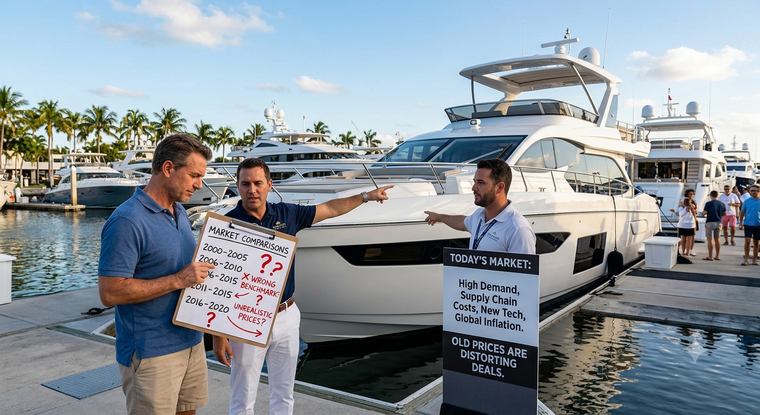
Old yacht prices are distorting today’s deals. Here’s why buyers comparing 2000, 2005, 2010, 2015, or 2020 prices to the current yacht market are using the wrong benchmark.
Your Last Yacht Is Distorting What You Think Today’s Yacht Should Cost
Old yacht prices are distorting today’s deals. Here’s why buyers comparing 2000, 2005, 2010, 2015, or 2020 prices to the current yacht market are using the wrong benchmark.
One of the hardest conversations in yacht brokerage right now starts with a sentence I hear constantly:
“I bought a boat like this for much less.”
Usually, the buyer is right.
He may have bought a comparable yacht in 2000, 2005, 2010, 2015, or even 2020 for a number that makes today’s asking prices look unreasonable.
The problem is not his memory. The problem is the benchmark.
A yacht purchased 10, 15, or 20 years ago is not a valid pricing reference for the yacht market today. The dollar changed. Labor costs changed. Materials changed. Equipment changed. Regulations changed. New-yacht pricing changed. The global fleet changed. And the supply of desirable late-model used yachts changed with it.
This does not mean every yacht on the market is fairly priced. Many are not.
It does not mean yachts have stopped depreciating. They have not.
And it certainly does not mean a buyer should simply pay whatever a seller asks.
But it does mean that a buyer cannot walk into today’s yacht market carrying a 2005 price expectation and expect the market to conform to it.
The Number You Remember Is a Nominal Number
Start with the simplest issue: money itself.
According to the U.S. Bureau of Labor Statistics, the Consumer Price Index has risen substantially over the periods many experienced yacht owners use as their mental reference points. The purchasing power of a dollar in the mid-2000s is not the purchasing power of a dollar today.
That matters because yacht buyers often remember the purchase price of their last boat as if the number were fixed in time.
It is not.
A buyer may remember paying $5 million for a yacht years ago and conclude that a similar yacht should still cost somewhere near $5 million. But that comparison ignores the change in the value of money before we even discuss the yacht itself.
General inflation is not a yacht valuation formula. A yacht is not a basket of consumer goods, and applying CPI directly to an old purchase price does not tell you what a specific boat is worth today.
But CPI does expose the flaw in using an old nominal purchase price as a modern market benchmark.
The number stayed in your memory. Its purchasing power did not.
The Yacht Market Expanded
The yacht market being compared today is not the same market many buyers remember.
More yachts have been built. More semi-custom series have entered the market. Buyer expectations have changed. Volume, stabilization, beach clubs, tender garages, connectivity, glazing, efficiency, and onboard systems are now evaluated differently than they were 10 or 20 years ago.
At the same time, yesterday’s new yachts became today’s brokerage inventory.
That creates a market with more boats, more price points, and much greater differentiation between yachts that may look similar on paper.
Age alone no longer tells the story.
A 15-year-old yacht with documented maintenance, major machinery work, updated electronics, and a serious refit may compete very differently from a neglected sistership of the same year.
Two yachts with the same builder, model, and year can be worth materially different amounts.
Buyers and Sellers Are Often Anchored to Different Years
This is where many yacht deals break down.
The seller is anchored to one number. The buyer is anchored to another.
The seller may remember what he paid, what he spent on improvements, and what a similar boat was listed for.
The buyer may remember what his last yacht cost 10 or 20 years ago.
Neither number necessarily establishes current yacht market value.
The market does.
- Current competing inventory matters.
- Recent comparable yacht sales matter.
- Time on market matters.
- Price reductions matter.
- Condition matters.
- Maintenance history matters.
- Refit quality matters.
- Specifications matter.
- Location matters.
- The cost of deferred maintenance matters.
Ultimately, the price at which a qualified buyer and a motivated seller are willing to transact matters.
Everything else is an anchor.
The Yacht Market Is Not Returning to 2005
This point requires precision.
Yacht prices can fall. Some segments are already more favorable to buyers than others. Inventory can rise. Transaction volume can slow. Asking prices can be reduced. Individual yachts can sit on the market until their sellers become realistic.
So this is not an argument that yacht prices only move in one direction.
It is an argument that a market correction does not reverse 10, 15, or 20 years of economic and industry change.
A softer yacht brokerage market does not recreate 2010.
A motivated seller does not restore the purchasing power of a 2005 dollar.
A price reduction does not make the cost structure of modern yacht construction disappear.
Waiting for better value can be rational.
Waiting for the entire yacht market to return to the nominal prices you remember from another era is a different bet entirely.
Sellers Have to Adjust Too
Buyers are not the only people who get trapped by old numbers.
Sellers do it constantly.
Money spent on a yacht is not automatically recoverable.
A $2 million refit does not necessarily add $2 million to market value.
The original purchase price does not create a floor.
The outstanding loan balance does not create a floor.
The amount the owner needs to get does not create a floor.
And an asking price on another unsold yacht is not proof of value.
The current market does not care what either side needs the number to be.
That is why realistic yacht brokerage requires uncomfortable conversations in both directions.
A broker should not tell a buyer that every asking price is justified.
A broker should not tell a seller that every dollar spent will come back at resale.
The job is to determine where the current yacht market actually exists.
The Right Question Has Changed
The wrong question is:
“Why does this yacht cost so much more than the one I bought years ago?”
The better questions are:
- What are the real alternatives available today?
- What have comparable yachts actually traded for?
- How long has this yacht been on the market?
- What capital expenditure is approaching?
- What has already been replaced or refitted?
- What would it cost to buy new?
- What would it cost to bring the cheaper alternative to the same condition?
That is how experienced buyers should evaluate the modern yacht market.
Not by forgetting what they paid for their last yacht.
By understanding that the number belongs to the year in which they paid it.
The market can be expensive. The market can be irrational. The market can correct.
But the market does not owe any of us the prices we remember.