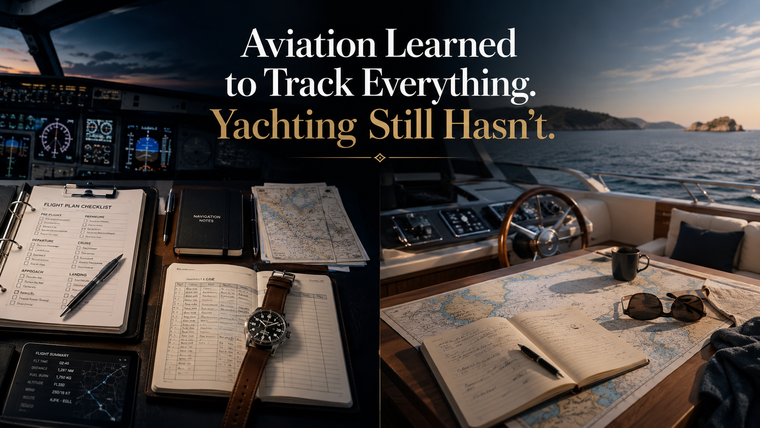
There is a reason aviation feels different from yachting.
In aviation, every serious operator understands that the aircraft, the pilot, the maintenance history, the inspection trail, the weather, the route, and the risk profile all matter. The aircraft is not treated like a toy. It is treated like a life-support system with wings.
Yachting should be viewed the same way.
A yacht may move slower than an airplane, but the underlying truth is similar: people are trusting their lives to a complex machine operating in an unforgiving environment. Engines fail. Fuel systems fail. Steering systems fail. Electrical systems fail. Through-hulls fail. Stabilizers, generators, batteries, pumps, navigation electronics, fire suppression systems, and safety gear all matter.
The difference is cultural.
Aviation was shaped by obsessive people who tracked everything because they understood that small details could become fatal. Yachting, especially outside the most professionally managed vessels, still has too much of a laid-back culture around information, maintenance records, and operational history.
That gap is exactly why The Yacht Trader exists.
Aviation Was Built by Obsessive People
Aviation did not become serious by accident.
It was shaped by people who were almost irrationally focused on machines, time, distance, performance, control, and repeatability.
Alberto Santos-Dumont is one of the clearest examples. He was not simply a romantic adventurer floating over Paris. He was a Brazilian aviation pioneer who dedicated his life to flight, experimentation, and mechanical improvement. He came from a wealthy Brazilian coffee family, moved through the social world of Paris, and used that freedom to chase aviation with total focus. (en.wikipedia.org)
That detail matters.
Santos-Dumont lived in a world of cafés, salons, style, and elegance, but his real legacy was not leisure. His legacy was obsession. He cared about timing, weight, balance, propulsion, fuel, distance, control, and whether a machine could perform again and again under pressure.
Even the wristwatch story proves the point.
Santos-Dumont did not invent the wristwatch. That would be a sloppy claim. The better story is more important: in 1904, Louis Cartier created a watch for Santos-Dumont so he could tell time while flying. A pocket watch worked at dinner. It did not work when both hands were needed to control an aircraft. Cartier still describes the Santos-Dumont watch as being conceived for aviators to tell time mid-flight. (cartier.com)
That is the aviation mindset.
Even time became operational.
Howard Hughes is another example. He was obsessive about performance, engineering, speed, and design. His Hughes H-1 Racer set a world speed record in 1935, and the aircraft used details like retractable landing gear, flush rivets, aerodynamic fairings, and wind tunnel testing to reduce drag and improve performance. The Smithsonian records those design details because they mattered. They were not decoration. They were engineering decisions.
Aviation rewarded people who believed details mattered.
Yachting often rewards people who make things look effortless.
That is part of the problem.
Yachting Inherited Romance Before Discipline
Yachting has a different cultural origin.
A lot of boating culture, especially sailing culture, comes from patience, instinct, weather, seamanship, and adaptation. There is real skill in that. Good sailors read wind, current, clouds, pressure, water, and timing better than most people ever will.
But that same culture can influence the broader yacht industry in the wrong direction.
Sailing teaches you to work with uncertainty. Modern yacht ownership requires you to reduce uncertainty.
Those are not the same thing.
The old romantic idea is: let the wind take you, adjust as you go, trust your feel, trust your captain, trust the sea, trust the people who know the boat.
That may be beautiful on a small sailing vessel with an experienced sailor.
It is not enough for a modern yacht.
A 60-foot, 80-foot, or 120-foot yacht is not just a lifestyle object. It is a complex platform with engines, generators, batteries, fuel systems, navigation electronics, hydraulic systems, stabilizers, plumbing, fire suppression, through-hulls, steering gear, tenders, safety equipment, structural systems, and documentation requirements.
“We’ll figure it out as we go” is not a maintenance plan.
“The captain knows the boat” is not a recordkeeping system.
“The owner took care of it” is not due diligence.
“The survey will catch it” is not enough.
The wind can take a sailor somewhere.
It should not take the yacht industry’s documentation standards with it.
Aviation Tracks Risk. Yachting Still Scatters It.
Modern aviation has a formal safety culture built around documentation, procedure, reporting, and risk management.
The FAA defines a Safety Management System as a formal, organization-wide approach to managing safety risk and making sure safety controls are effective. (faa.gov)
That sentence sounds dry, but it is the reason aviation became what it is.
Aviation investigates.
Aviation records.
Aviation studies failures.
Aviation creates procedures.
Aviation tracks maintenance.
Aviation treats information as part of survival.
Yachting has some of this at the classed, commercial, and professionally managed level. But across the broader yacht market, the information is still fragmented.
A yacht’s true condition may be spread across old surveys, service invoices, broker notes, captain knowledge, yard records, manufacturer documents, insurance requirements, owner memory, WhatsApp messages, emails, PDFs, and conversations that disappear when someone changes jobs.
That is not a serious information system.
It is a scavenger hunt.
And in yacht sales, that scavenger hunt becomes expensive.
Buyers lose confidence.
Sellers lose credibility.
Brokers waste time.
Surveys become deal killers.
Insurance becomes harder.
Financing gets delayed.
Negotiations become emotional because the facts are not organized.
The market does not need more adjectives.
It needs better records.
A Bad Vessel Can Be as Dangerous as a Bad Aircraft
A poorly maintained aircraft is dangerous because altitude, speed, and mechanical failure leave little room for error.
A poorly maintained vessel is dangerous for different reasons: fire, flooding, grounding, collision, loss of propulsion, fuel contamination, electrical failure, carbon monoxide, failed pumps, failed steering, failed navigation, or failed safety systems offshore.
Different environment. Same principle.
When people step aboard, they are trusting the machine.
They are trusting that the engines were serviced properly.
They are trusting that the bilge pumps work.
They are trusting that the fire systems are current.
They are trusting that the batteries were installed correctly.
They are trusting that the hull, shafts, rudders, steering, fuel tanks, generators, and electronics are sound.
They are trusting that the owner, captain, broker, surveyor, yard, and service providers did their jobs.
Trust is not a system.
Records are a system.
The U.S. Coast Guard’s 2024 Recreational Boating Statistics reported 3,887 boating incidents, 556 deaths, 2,170 injuries, and approximately $88 million in property damage. Operator inattention, improper lookout, operator inexperience, machinery failure, and navigation rules ranked among the top primary contributing factors. (uscgboating.org)
That does not mean every yacht is unsafe.
It means boating safety depends on discipline, maintenance, information, preparation, and accountability.
Aviation already learned that.
Yachting still needs to catch up.
The Yacht Trader Is Built Around the Missing Discipline
The Yacht Trader exists because the yacht market needs a better information layer.
Not more vague listings.
Not more recycled descriptions.
Not more pretty photos hiding weak documentation.
Not more buyers discovering the truth only after survey.
The industry needs a cleaner way to understand the vessel itself:
- Ownership history
- Maintenance history
- Survey history
- Refit history
- Equipment lists
- Service intervals
- Known upgrades
- Known deficiencies
- Safety equipment
- Documentation status
- Broker and seller disclosures
- Comparable market data
- Buyer questions
- Due diligence workflow
This is the bridge between aviation and yachting.
Aviation learned that safety improves when the machine is documented, inspected, tracked, and studied. Yachting still relies too often on scattered PDFs, memory, reputation, captain notes, broker comments, yard invoices, and conversations that disappear.
That is not good enough.
The Yacht Trader is not trying to remove the romance from yachting. The ocean should still feel like freedom. Boats should still create adventure, privacy, family time, status, travel, and escape.
But freedom without information is not sophistication.
It is risk.
The Future of Yachting Is Traceability
The next generation of yacht ownership will demand more transparency.
Buyers are more sophisticated. Insurance is more demanding. Financing is more careful. Surveyors are under pressure. Brokers are expected to defend pricing with facts, not adjectives.
The yachts that are easiest to understand will be easier to trust.
The yachts with better records will be easier to insure, finance, survey, list, and sell.
The brokers who can present clean information will outperform brokers relying only on charm.
The owners who document properly will protect value better than owners who treat maintenance history as an afterthought.
Aviation became safer because obsessive people forced details to matter.
Yachting does not need to become aviation. Boats are not airplanes, and the sea is not the sky.
But yachting does need to adopt more of aviation’s discipline.
Because whether you are flying over land or running offshore, the machine matters.
And when lives are on board, laid-back is not a safety strategy.